
Arthroscopic Ankle Surgery in Mysore & Beyond
Advanced keyhole ankle surgery for ligament reconstruction, cartilage repair, loose body removal, and posterior ankle conditions — by Dr. Shirish M. Narsapur, one of Karnataka’s rare surgeons performing the full spectrum of ankle arthroscopy.
A Rare Subspecialty — Available in Karnataka
Ankle arthroscopy — and particularly posterior ankle arthroscopy — is one of the most technically demanding subspecialties in orthopedic surgery. The ankle joint is small, the anatomy is complex, and the proximity of nerves, tendons, and blood vessels demands a high level of surgical expertise and experience. As a result, very few orthopedic surgeons in Karnataka perform ankle arthroscopy with the breadth and regularity that Dr. Shirish Narsapur does.
Patients who have been told their ankle problem “cannot be treated surgically” or who have been referred to distant cities for specialist care can now access the full range of arthroscopic ankle procedures — including the technically challenging posterior approach — across multiple locations in Karnataka and internationally in Muscat.
What Is Arthroscopic Ankle Surgery?
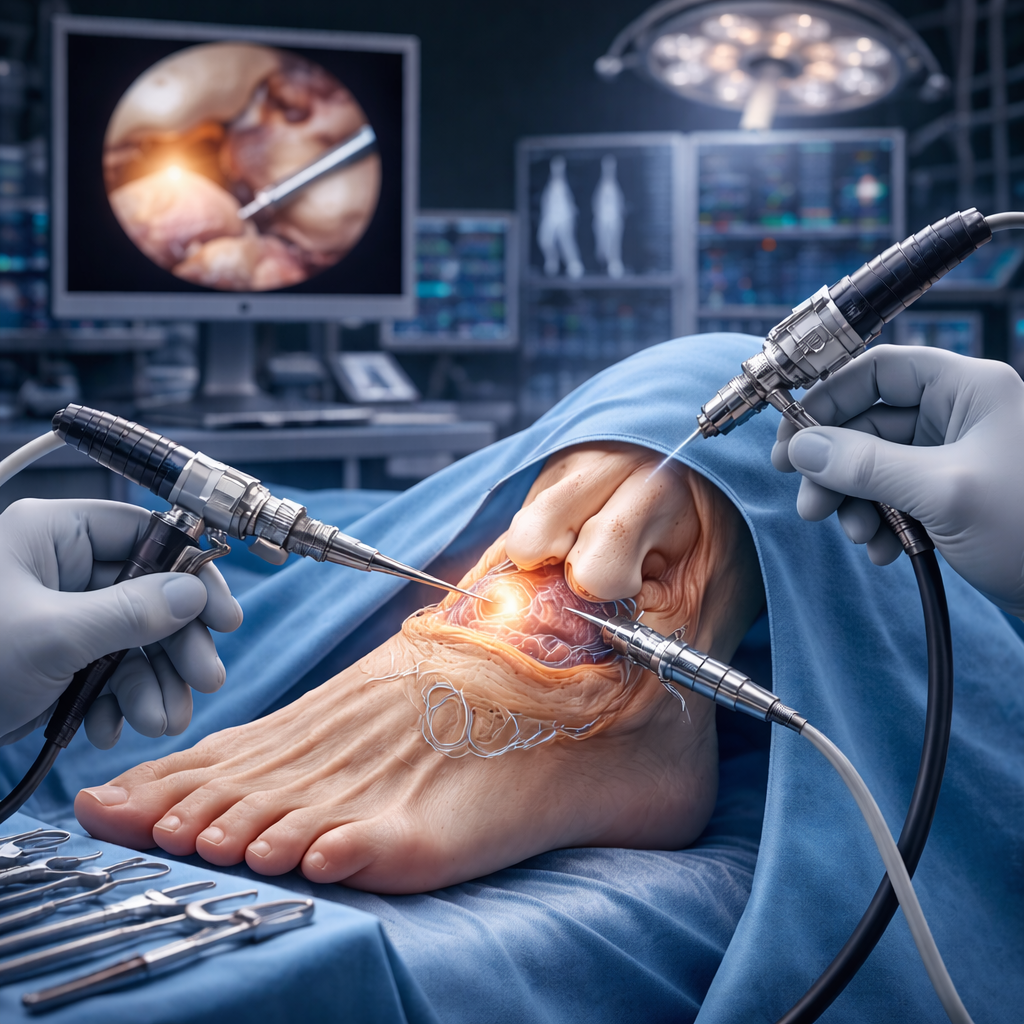
Arthroscopic ankle surgery is a minimally invasive technique in which a miniaturised high-definition camera (arthroscope) is inserted into the ankle joint through tiny incisions, allowing the surgeon to see and treat conditions inside the joint without the large incision and prolonged recovery of open surgery.
The ankle is a complex, tight joint — making arthroscopy technically more demanding than in larger joints like the knee or shoulder. Instrumentation must be precise, anatomical knowledge must be extensive, and surgical experience in this specific area is essential for safe and effective outcomes. This is why ankle arthroscopy remains a subspecialty skill performed by relatively few surgeons.
Athletes and active individuals — who place high demands on their ankles and cannot afford prolonged downtime — are the most common beneficiaries of arthroscopic ankle surgery. Compared to open procedures, arthroscopy delivers faster recovery, less pain, and a quicker return to sport.
Ankle Procedures We Perform
ATFL Reconstruction (Anterior Talofibular Ligament)
CFL Repair (Calcaneofibular Ligament)
Osteochondral Cartilage Repair
Loose Body Removal
Posterior Ankle Arthroscopy
Ankle Impingement Surgery
Sports & Athletes We Serve
Cricket
Football
Running
Dance
Badminton
Gym / Fitness
Volleyball
Combat Sports
Sport-Specific Rehabilitation Protocols
Early weight-bearing, rapid functional recovery
Protected weight-bearing, progressive proprioception, sport-specific agility phase
Non-weight-bearing phase critical for cartilage maturation
Rapid return for dancers and sprinters; plantarflexion restored early
Range of motion priority; early return to training
✦ All timelines are approximate. Each rehabilitation protocol is designed individually based on the patient's procedure, sport, and competitive demands.
Why Choose Dr. Shirish Narsapur?
One of the Few in Karnataka
Posterior Ankle Expertise
Athlete-Centred Approach
Individually Tailored Rehab
Multi-Location Access
Honest, Evidence-Based Counsel
Frequently Asked Questions
What is arthroscopic ankle surgery?
Arthroscopic ankle surgery is a minimally invasive surgical technique in which a tiny camera (arthroscope) and specialised instruments are inserted into the ankle through small incisions. It allows the surgeon to diagnose and treat conditions inside the ankle joint — including ligament tears, cartilage damage, loose bodies, and posterior impingement — without the large incision and tissue disruption of open surgery. The result is less post-operative pain, faster recovery, and a quicker return to sport.
What is ATFL and CFL reconstruction?
The ATFL (anterior talofibular ligament) and CFL (calcaneofibular ligament) are the primary lateral stabilisers of the ankle — the ligaments most commonly torn in ankle sprains. When chronic laxity causes recurrent giving-way and instability that doesn’t respond to physiotherapy, arthroscopic Brostrom-type reconstruction tightens and reattaches these ligaments, restoring lateral ankle stability. The procedure is highly effective in athletes with chronic ankle instability, allowing full return to competitive sport within 3–4 months.
What is posterior ankle arthroscopy and why is it rare?
Posterior ankle arthroscopy is performed with the patient face-down using portals placed behind the ankle, providing access to the back of the ankle and subtalar joint — areas inaccessible from the front. It treats os trigonum syndrome, posterior impingement, flexor hallucis longus tendon pathology, and posterior cartilage lesions. It is technically demanding due to the proximity of important nerves and vessels behind the ankle, and is performed by only a small number of surgeons in Karnataka — making Dr. Narsapur’s expertise in this technique a significant advantage for patients in the region.
What are loose bodies in the ankle and how are they treated?
Loose bodies are fragments of cartilage or bone that break free and float within the ankle joint, causing locking, sharp catching pain, and sudden instability during activity. Arthroscopic loose body removal extracts these fragments through small portals with no open incision required. Athletes typically notice immediate improvement in mechanical symptoms following the procedure, with return to light sport within 6–8 weeks.
What is an osteochondral lesion of the ankle?
An osteochondral lesion (OCL) is a defect in the cartilage and underlying bone on the talar dome — the weight-bearing surface of the ankle joint. Usually caused by ankle sprains or repetitive impact, OCLs cause deep ankle pain, swelling, and reduced athletic performance. Arthroscopic treatment options include microfracture (to stimulate cartilage regeneration), debridement, and osteochondral grafting for larger defects. Early treatment is critical — untreated OCLs enlarge progressively and can lead to ankle arthritis.
What is ankle impingement and can it be treated arthroscopically?
Ankle impingement occurs when tissue or bony spurs are pinched within the joint during movement. Anterior impingement — common in footballers and runners — causes pain at the front of the ankle when lifting the foot. Posterior impingement — common in dancers and sprinters — causes pain at the back when pointing the foot. Both are effectively treated arthroscopically by removing the impinging bone spur or soft tissue, restoring full pain-free range of motion and allowing return to sport within 6–8 weeks.
What is os trigonum syndrome?
Os trigonum is an accessory (extra) bone present behind the ankle in some individuals. In most people it causes no symptoms, but in athletes who repeatedly plantarflex the ankle — particularly dancers, gymnasts, and sprinters — it can become painfully compressed, causing posterior ankle pain and restricted range of motion. Arthroscopic os trigonum removal via the posterior approach resolves the impingement definitively, with return to dance or sport typically within 6–10 weeks.
What is the recovery time after arthroscopic ankle surgery?
Recovery varies by procedure. Loose body removal and debridement allow return to sport within 6–8 weeks. Ligament reconstructions (ATFL/CFL) require 3–4 months. Cartilage repair (microfracture, OCL treatment) requires a protected non-weight-bearing period followed by a progressive return to sport over 4–6 months. Posterior arthroscopy for os trigonum allows return to dance or sprint sport within 6–10 weeks. All protocols are individually tailored — not generic — based on the patient’s sport, competition level, and surgical findings.
Can chronic ankle instability be fixed permanently with surgery?
Yes. Chronic ankle instability that persists despite physiotherapy — characterised by repeated giving-way, recurrent sprains, and loss of confidence in the ankle — is an excellent surgical indication. Arthroscopic Brostrom-type ATFL/CFL reconstruction restores the native lateral ligament anatomy with high success rates. The majority of athletes who undergo the procedure and complete their rehabilitation return to full sport without recurrence of instability.
Where does Dr. Narsapur perform arthroscopic ankle surgery?
Dr. Shirish Narsapur performs arthroscopic ankle surgery across multiple locations: Mysore, Bangalore, and Raichur in Karnataka, India, and internationally in Muscat, Oman. Contact the clinic at +91 9845509184 or care@jointsurgeonindia.com to arrange a consultation at your nearest location.