
Arthroscopic Hip Surgery in Mysore
A rare subspecialty — available here. Dr. Shirish M. Narsapur brings arthroscopic hip surgery to Mysore for the first time, offering FAI treatment, acetabular labral repair, and loose body removal through minimally invasive keyhole techniques.
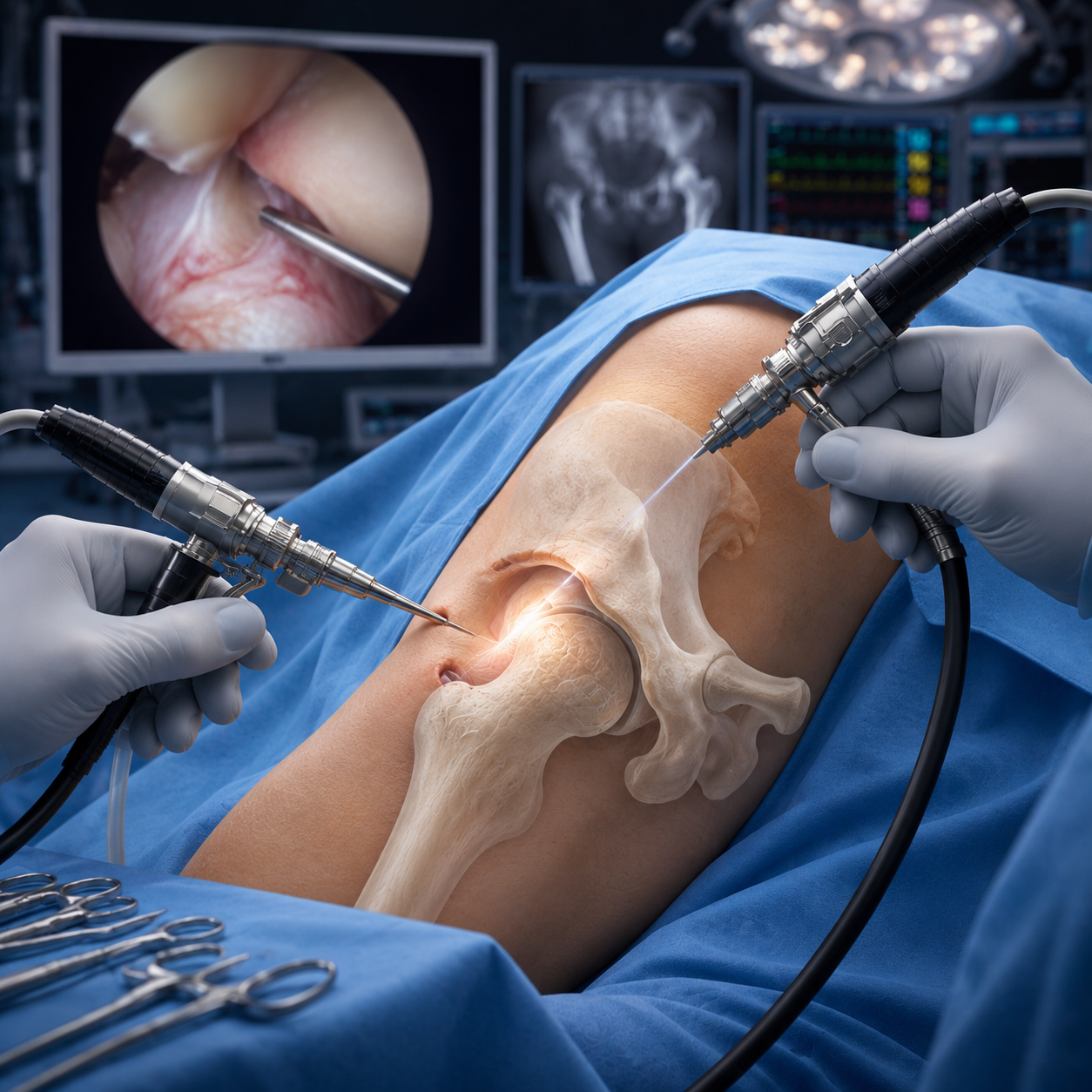
Why Hip Arthroscopy Is Exceptionally Rare
Hip arthroscopy sits at the frontier of orthopaedic surgery. Unlike the knee or shoulder — where arthroscopy is widely practised — the hip joint is deep within the body, tightly constrained, and surrounded by critical neurovascular structures. To access it safely, the joint must be distracted using a specialised traction table, and curved instruments must navigate the unique anatomy of the ball-and-socket joint.
This technical complexity means that hip arthroscopy requires dedicated subspecialty training beyond standard orthopaedic surgery. As a result, it remains one of the rarest procedures available in India — and in Karnataka, only a handful of surgeons perform it at all.
Dr. Shirish Narsapur is the only surgeon in Mysore offering this procedure — making specialist hip arthroscopy accessible in the region for the first time.
Only One
Surgeon in Mysore performing arthroscopic hip surgery
Very Few
Surgeons in Karnataka with the training and equipment to perform hip arthroscopy safely
Specialist
Traction equipment, curved instrumentation, and dedicated subspecialty training required
Available Now
In Mysore, Bangalore, Raichur & Muscat — no need to travel to a distant city
What Is Arthroscopic Hip Surgery?
Arthroscopic hip surgery is a minimally invasive surgical technique in which a tiny high-definition camera (arthroscope) is inserted into the hip joint through small incisions, allowing the surgeon to see and treat pathology inside the joint without the extensive tissue disruption of open hip surgery.
The procedure requires the patient to be positioned on a specialised traction table that gently distracts (opens up) the tight hip joint to create the working space needed for the arthroscope and instruments. This technical requirement — combined with the complex anatomy and proximity of major vessels and nerves — is why hip arthroscopy remains an advanced subspecialty skill in orthopaedic surgery.
Although the indications for hip arthroscopy are more selective than for knee or shoulder arthroscopy — the procedure is not appropriate for patients with advanced hip arthritis — for the right candidates, it offers the ability to treat significant intra-articular pathology with minimal disruption, faster recovery, and the potential to delay or prevent the need for hip replacement surgery.
Procedures Performed
Femoroacetabular Impingement (FAI) Treatment
Acetabular Labral Repair
Loose Body Removal
Who Is — and Is Not — a Candidate?
✦ Good Candidates
- Confirmed FAI (cam, pincer, or mixed) with labral or cartilage damage
- Acetabular labral tear causing mechanical symptoms unresponsive to conservative treatment
- Loose bodies causing pain and restricted movement
- Preserved hip cartilage (Tönnis grade 0–1)
- Younger, active patients with groin pain and restricted flexion
- Athletes with hip pain affecting performance
✦ Less Suitable / Requires Discussion
- Advanced hip osteoarthritis (Tönnis grade 2–3) — replacement may be more appropriate
- Significant joint space narrowing on X-ray
- Severe acetabular dysplasia requiring realignment osteotomy
- Obesity with very limited hip range of motion
- Avascular necrosis of the femoral head
Rehabilitation & Recovery
- Crutches for 2–4 weeks with restricted weight-bearing
- Early range-of-motion exercises begin within days
- Progressive strengthening from week 6
- Sport-specific conditioning from month 3
- Full return to competitive sport at 4–6 months
- Weight-bearing as tolerated from day one
- Rapid return to walking and daily activities
- Light exercise from 2–3 weeks
- Full activity return at 4–6 weeks
- Fastest recovery of all hip arthroscopy procedures
- Protected weight-bearing phase: 3–4 weeks
- Hip flexion restrictions observed for labral healing
- Hydrotherapy introduced early for range of motion
- Strengthening and sport conditioning from month 3
- Return to unrestricted sport at 5–6 months
✦ All rehabilitation protocols are individually designed. Timelines are approximate and adapted to each patient's procedure, age, and functional goals.
Why Choose Dr. Shirish Narsapur?
The Only Surgeon in Mysore Performing Hip Arthroscopy
One of Very Few in Karnataka
Honest Patient Selection
Joint-Preserving Philosophy
Individually Tailored Rehabilitation
International Practice, Local Presence
Frequently Asked Questions
What is arthroscopic hip surgery?
Arthroscopic hip surgery is a minimally invasive procedure in which a tiny camera and specialised instruments are inserted into the hip joint through small incisions. It allows diagnosis and treatment of intra-articular conditions — including femoroacetabular impingement, labral tears, and loose bodies — without the major incision and prolonged recovery of open hip surgery. The hip’s depth and tight anatomy make it one of the most technically demanding joints to arthroscope, which is why very few surgeons in Karnataka perform it.
What is femoroacetabular impingement (FAI)?
Femoroacetabular impingement (FAI) occurs when abnormal bone morphology causes the femoral head (ball) and acetabulum (socket) to pinch during hip movement. Cam FAI involves excess bone on the femoral head; pincer FAI involves overcoverage of the socket. Both progressively damage the labrum and cartilage. FAI causes groin pain — especially with sitting, flexion, and pivoting — and if untreated, leads to early hip arthritis. Arthroscopic correction reshapes the bone to eliminate the impingement.
What are the symptoms of a hip labral tear?
A hip labral tear typically causes deep groin pain, a clicking or locking sensation during hip movement, and a sense of instability or giving way. Pain often worsens with prolonged sitting, pivoting, or hip flexion. Symptoms are frequently mistaken for groin muscle strains or hip flexor problems, leading to significant delays in diagnosis. An MRI (or MR arthrogram in selected cases) is required to confirm a labral tear.
What are loose bodies in the hip?
Loose bodies are fragments of cartilage or bone that break free within the hip joint. In the constrained space of the hip, even small fragments cause significant symptoms — sharp catching pain, sudden locking, and restricted movement. Arthroscopic loose body removal extracts these fragments without open surgery, with rapid relief of mechanical symptoms and a return to full activity within 4–6 weeks.
Is Dr. Narsapur the only surgeon performing hip arthroscopy in Mysore?
Yes. Dr. Shirish Narsapur is currently the only surgeon in Mysore performing arthroscopic hip surgery, and one of very few in Karnataka. Hip arthroscopy requires a specialised traction table, curved instruments specifically designed for the hip, and dedicated subspecialty training — barriers that mean the procedure is offered by very few surgeons in the state. Patients no longer need to travel to Bangalore, Chennai, or Mumbai to access this level of hip care.
Can FAI lead to hip arthritis if left untreated?
Yes. Untreated FAI causes repetitive mechanical damage to the labrum and articular cartilage with every hip movement. Over time this progressive destruction leads to early-onset hip osteoarthritis — particularly in younger, active patients. Arthroscopic FAI correction and labral repair, performed before significant cartilage loss has occurred, can halt this degenerative process and significantly delay or prevent the need for total hip replacement.
Who is a suitable candidate for hip arthroscopy?
Ideal candidates are patients with confirmed FAI and labral or cartilage damage, isolated acetabular labral tears, or loose bodies — all with preserved hip joint cartilage. Hip arthroscopy is most effective before significant arthritis has developed. Patients with advanced osteoarthritis, severe joint space narrowing, or significant dysplasia are generally better candidates for alternative treatments including total hip replacement. A thorough consultation with clinical examination and imaging review is essential to determine suitability.
What is the recovery time after hip arthroscopy?
Recovery varies by procedure. Loose body removal allows return to full activity within 4–6 weeks. FAI treatment with labral repair requires crutches for 2–4 weeks and a structured rehabilitation programme, with return to sport at 4–6 months. All protocols are individually tailored — not generic — based on the patient’s surgery, activity level, and goals. Dr. Narsapur designs each rehabilitation plan personally.
Why is hip arthroscopy so rarely available in Karnataka?
Hip arthroscopy is one of orthopaedic surgery’s most technically demanding procedures. The hip is a deep ball-and-socket joint with minimal natural space — requiring a specialised traction table to distract the joint, uniquely curved instruments to work inside it, and proximity to major neurovascular structures that demands exceptional precision. These requirements mean that dedicated subspecialty training and specific equipment are mandatory — and very few surgeons in Karnataka have acquired both.
Where does Dr. Narsapur perform hip arthroscopy?
Hip Pain That Won't Go Away?
Groin pain, restricted movement, or clicking in the hip could be FAI or a labral tear — conditions now treatable in Mysore. Book an assessment with Dr. Shirish Narsapur.
Call us: