
Joint Replacement Surgery for Knee, Hip & Shoulder
When severe arthritis has progressed beyond the reach of preservation — Dr. Shirish Narsapur delivers precise, expertly executed joint replacement surgery using premium US and German implants, with navigation and robotic assistance where warranted, and rehabilitation tailored to every individual.
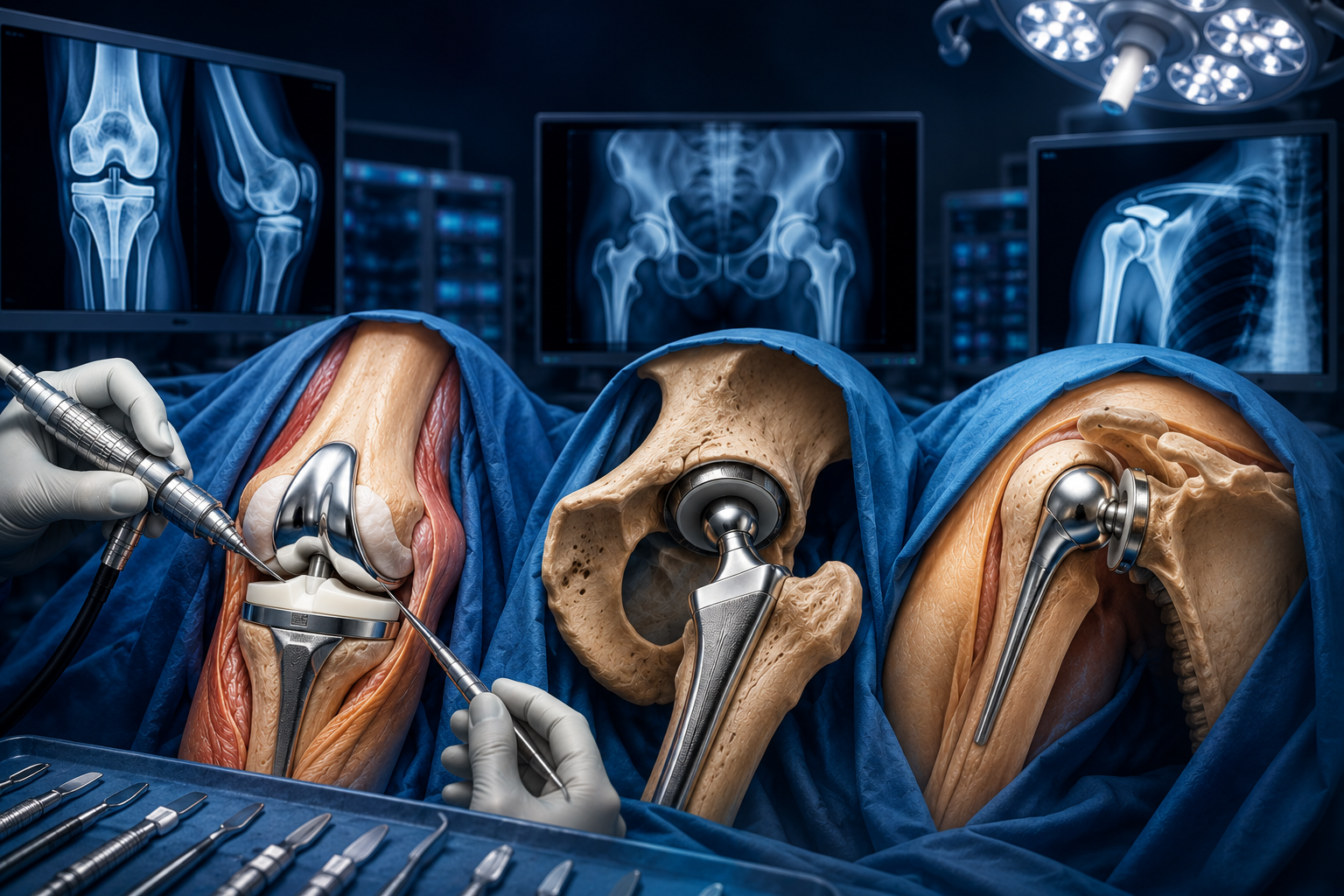
Knee
Total · Partial · Bilateral
Hip
Shoulder
Total · Reverse Shoulder
Preservation is Always the First Priority
Dr. Shirish Narsapur’s approach to joint disease begins — and wherever possible, ends — with preservation. Arthroscopic surgery, when performed at the right stage of disease, can treat the root cause of joint damage, relieve pain, restore function, and significantly delay or prevent the need for replacement. This is why the majority of Dr. Narsapur’s surgical practice is arthroscopic and joint-preserving.
Joint replacement is not a first resort. It is the right answer only when severe arthritis has progressed to the point where the joint surfaces are destroyed beyond repair — where pain is constant, function is severely compromised, and conservative treatments have been appropriately exhausted.
When that point arrives, joint replacement is a genuinely transformative procedure. The relief from years of arthritic pain, restored mobility, and return to an active life make it one of the most impactful surgeries in all of medicine — and one that Dr. Narsapur performs with the same precision and care as every other procedure in his practice.
A Note on Surgical Volume — and What It Means
Dr. Narsapur performs significantly more arthroscopic procedures than joint replacements. This is not because he lacks the expertise for replacement — it is because his philosophy of early intervention and joint preservation means that many patients who come to him are treated arthroscopically before their joints deteriorate to the point of requiring replacement.
When patients do present with end-stage arthritis — where preservation is no longer viable — joint replacement is performed with full competence and the same attention to surgical precision, implant selection, and individualised rehabilitation that defines his entire practice.
Lower replacement volume is a marker of a preservation-first philosophy — not a limitation.
The Clinical Pathway: Preservation → Replacement
Clinical exam + imaging
Physio, medication, injections
Joint preservation — if viable
When arthritis is end-stage
Individually tailored recovery
Joint Replacement Procedures
- Knee Replacement
- Hip Replacement
- Shoulder Replacement
Enhance user experience with Advanced Tabs, allowing seamless content navigation. Organize information efficiently while keeping the interface clean and interactive. Perfect for FAQs, product details, or multi-section content.
Enhance user experience with Advanced Tabs, allowing seamless content navigation. Organize information efficiently while keeping the interface clean and interactive. Perfect for FAQs, product details, or multi-section content.
Implants & Technology
The right implant, precisely placed — every time.
US & German Implants
High-quality implants from leading American and German manufacturers — selected for their long-term clinical data, materials science, and proven performance in demanding patient populations.
Navigation-Assisted Surgery
Computer navigation provides real-time intraoperative data on implant alignment, leg length, and joint balance — employed when it adds meaningful precision beyond standard technique.
Robotic Assistance When Warranted
Robotic-assisted joint replacement offers enhanced accuracy in bone preparation and implant placement. Used selectively — where the complexity of the case or the patient’s anatomy makes robotic assistance the most appropriate choice.
Individually Tailored Rehabilitation
Joint replacement is the surgery — rehabilitation is the recovery. Every patient receives a programme designed specifically for their procedure, their joint, their age, and their personal goals. Physiotherapy begins within 24 hours of surgery in most cases, and milestones are monitored and adjusted throughout the recovery process.
Walking with support within 24hrs. Stairs by week 2–3. Driving by week 6.
Higher initial demand — both knees rehabilitating simultaneously. Intensive physio required.
Faster recovery than TKR due to smaller incision and less bone removal.
Walking with frame within 24hrs. Hip precautions observed for 6–8 weeks.
Sling for 4–6 weeks. Pendulum exercises from day one. Active motion introduced progressively.
Deltoid retraining critical. Progressive strengthening from week 6. Full function at 6–9 months.
✦ All timelines are approximate and individually adapted. Dr. Narsapur designs each rehabilitation plan based on the patient's surgery, age, fitness, and personal goals.
Why Choose Dr. Shirish Narsapur?
Preservation-First Philosophy
Full Replacement Expertise
Premium Implants with Navigation & Robotics
Bilateral Knee — One Hospital Stay
Individually Tailored Rehabilitation
Multi-Location Access
Frequently Asked Questions
When is joint replacement surgery necessary?
Joint replacement is recommended when severe arthritis has destroyed the joint surfaces to the point where preservation is no longer viable — typically when pain is constant, daily function is significantly impaired, and conservative treatments including physiotherapy, medication, and injections have failed to provide adequate relief. Dr. Narsapur always explores joint-preserving arthroscopic options first. Replacement is the last step, not the first — but when it is the right answer, it is a highly effective and life-changing procedure.
Why does Dr. Narsapur perform more arthroscopy than replacements?
Dr. Narsapur’s surgical practice is predominantly arthroscopic and joint-preserving — because this is his primary philosophy: intervene early, preserve what is healthy, and avoid replacement for as long as the joint can be saved. Many patients who might be advised to undergo replacement elsewhere are successfully treated arthroscopically. When patients do present with end-stage arthritis that genuinely requires replacement, it is performed with full competence and expertise. A lower replacement volume reflects the success of his preservation-first approach — not a limitation in replacement capability.
What is total knee replacement surgery?
Total knee replacement (TKR) resurfaces the damaged arthritic surfaces of the knee joint — the distal femur, tibial plateau, and patella — with precision metal and plastic components. It eliminates the bone-on-bone pain of end-stage arthritis, corrects deformity, and restores stable, functional movement. Dr. Narsapur uses high-quality US and German implants, with navigation and robotic assistance employed when warranted to optimise alignment — the most critical factor in implant longevity.
Can both knees be replaced on the same day?
Yes. Bilateral simultaneous total knee replacement — replacing both knees in a single surgical session — is available for appropriately selected patients. It reduces overall hospital stay, requires only one anaesthetic, and allows both knees to recover together. Patient selection is important: it is most appropriate for medically fit individuals with severe arthritis in both knees. Hip and shoulder replacements, however, are generally staged as separate procedures, timed based on individual need and recovery.
What is unicompartmental (partial) knee replacement?
Unicompartmental knee replacement (UKR) resurfaces only the affected compartment of the knee — typically the medial (inner) side — leaving the healthy portions intact. Compared to total knee replacement, it involves a smaller incision, less bone removal, faster recovery, and typically a more natural knee feel. It is appropriate for patients with single-compartment arthritis, intact ligaments, and a reasonable range of motion. Dr. Narsapur carefully assesses each patient to determine whether partial or total replacement is the right choice.
What is reverse total shoulder replacement and when is it needed?
Reverse total shoulder replacement reverses the ball-and-socket positions — placing the metal ball on the shoulder blade and the socket on the humerus. This allows the deltoid muscle to power shoulder movement independently of the rotator cuff, making it essential for patients with rotator cuff arthropathy (arthritis caused by a massive, long-standing cuff tear), failed prior replacements, or complex fractures. Standard total shoulder replacement is used when the rotator cuff is intact.
What implants and technology does Dr. Narsapur use?
Dr. Narsapur uses high-quality implants from leading US and German manufacturers — selected for their proven clinical longevity and materials science. Computer navigation provides real-time intraoperative data on implant alignment and joint balance. Robotic assistance is employed selectively — for cases where the complexity of the anatomy or the precision required makes robotic guidance the most appropriate tool.
What is the recovery time after knee replacement?
Most patients walk with support within 24 hours of total knee replacement. By week 2–3, stairs are typically manageable. Return to driving and independence is usually achieved by 6 weeks. Full recovery — reaching the final functional plateau — occurs between 3 and 6 months. Unicompartmental replacement is faster: most patients return to daily activity within 3–4 weeks. All timelines are individually tailored based on the patient’s age, fitness, and progress.
Can joint replacement be avoided with early treatment?
In many cases, yes — particularly in younger and middle-aged patients whose arthritis is not yet end-stage. Conditions such as femoroacetabular impingement, rotator cuff tears, meniscal damage, and early cartilage lesions that are treated arthroscopically at the right time can prevent the progressive joint destruction that eventually necessitates replacement. This is why Dr. Narsapur advocates strongly for early assessment and joint-preserving intervention — because what is treatable arthroscopically today may require replacement tomorrow if left unaddressed.
Where does Dr. Narsapur perform joint replacement surgery?
Dr. Shirish Narsapur performs joint replacement surgery across multiple locations: Mysore, Bangalore, and Raichur in Karnataka, India, and internationally in Muscat, Oman. Contact the clinic at +91 9845509184 or care@jointsurgeonindia.com to arrange a consultation.